Import Cars from UAE to Algeria: The 2026 Complete Guide
 January 6, 2026
, 6 Min Read
January 6, 2026
, 6 Min Read

For decades, the “Gulf Spec” vehicle has been the gold standard for Algerian drivers—prized for high-performance air conditioning, rust-free chassis, and superior trim levels. With the stabilisation of the “Under 3 Years” import decree (Decree 23-74) and the 2025 Finance Law updates, importing a car from the UAE is once again a viable, albeit complex, reality.
 AI Quick Summary
This guide details the newly re-enabled and complex process for Algerians to import "Gulf Spec" vehicles from the UAE, outlining strict eligibility rules regarding vehicle age, fuel type, and ownership. While petrol cars incur significant duties, Electric Vehicles benefit from substantial tax reductions, making them a highly attractive import option despite the logistical and financial hurdles.
This summary was generated by AI using this article’s content.Read Next


Whether you are eyeing a Toyota Land Cruiser 300, a reliable Corolla, or taking advantage of the massive tax breaks on Electric Vehicles (EVs), this guide covers the end-to-end process of moving metal from Jebel Ali to Algiers.
Part 1: Eligibility & The “Golden Rules”
Before transferring a single Dirham, you must pass the “Zero-Tolerance” eligibility check. Algerian customs are notoriously strict; a discrepancy of even one day in vehicle age can result in the car being seized or returned.
1. The 3-Year Countdown
The car must be under 3 years old at the exact moment the filing is registered with Algerian customs—not the day you bought it in Dubai.
- Calculation: From the date of first registration (or manufacture date if unregistered) to the date of entry.
- Safe Buffer: Do not cut it close. Leave at least a 30-day buffer for shipping delays.
2. Fuel Type Restrictions
- Allowed: Petrol (Essence), Hybrid, Electric (EV), CNG/LPG.
- Banned: Diesel vehicles are strictly prohibited for personal importation under this regime.
- Engine Size: While there is no strict cap, engines larger than 1.8L (petrol) attract significantly higher duties.
3. The “One Every 3 Years” Rule
A resident individual can only import one vehicle every three years. This is tracked via your passport and national ID.
4. Payment Compliance
You cannot pay for the car using cash carried in a suitcase. The law requires payment via a Foreign Currency Account (Compte Devise) based in Algeria to prove the source of funds is legitimate.
Part 2: The Sourcing Strategy (UAE Side)
Finding the car is the easy part; finding the right car for export is harder.
The “Gulf Spec” vs. “Import” Trap
In Dubai, many cars are “US Specs” or “Canada Specs” that have been repaired after accidents (salvage titles).
- The Risk: Algerian customs require a Certificate of Conformity. A repaired US-spec car may fail inspection in Algiers or lack the proper paperwork.
- The Solution: Stick to GCC Specs (Gulf Cooperation Council). These cars comply with hot-weather standards and are easier to certify.
The EV Opportunity (The 2026 Sweet Spot)
If you are looking for ROI, import an Electric Vehicle.
- Petrol Cars: Subject to ~60% cumulative taxes.
- EVs: Subject to an 80% reduction on duties and taxes. A Tesla Model 3 or BYD seal from Dubai is drastically cheaper to land in Algeria than a petrol equivalent.
Part 3: The Export Process (Dubai RTA)
Once you have purchased the vehicle, you must convert it from a “UAE Road Car” to an “Export Asset.” This happens at the Roads & Transport Authority (RTA).
Location: Any RTA Customer Happiness Centre or Tasjeel/Shamil testing centre.
Step-by-Step Procedure:
- Technical Inspection: Inform the tester that the car is for “Export.” They will perform a chassis check and safety test. (Cost: ~AED 170).
- Remove Plates: Unscrew the Dubai/Abu Dhabi license plates.
- Counter Processing: Submit the following documents:
- Original Vehicle License (Mulkiya) or Possession Certificate.
- A passport copy of the exporter.
- UAE Export Insurance (mandatory, valid for 14 days).
- Issuance: You will receive the Export Certificate (valid for own name) and Blue Export Plates.
Total RTA Export Costs (Est.):
| Item | Cost (AED) |
| Export Certificate | 100 |
| Export Plates (Blue) | 70 – 100 |
| Innovation/Knowledge Fees | 20 |
| Export Insurance (14 Days) | ~150 – 250 |
| Total | ~AED 350 – 500 |
Part 4: Logistics & Shipping
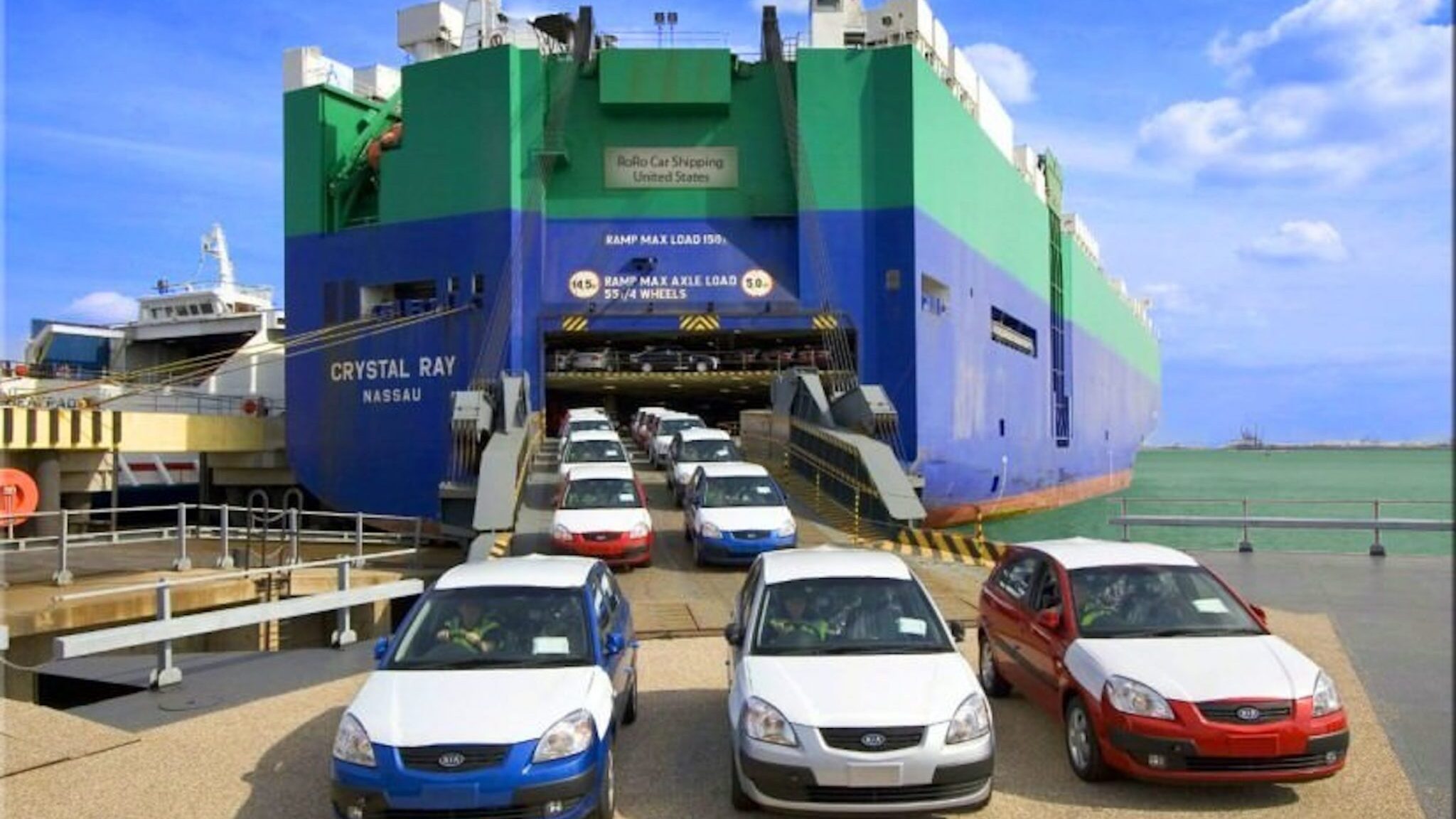
You have two options to ship from Jebel Ali Port to Algiers, Oran, Mostaganem, or Skikda.
1. RoRo (Roll-on/Roll-off)
The car is driven onto the ship.
- Pros: Cheapest option (~AED 2,800 – AED 3,500).
- Cons: You cannot leave personal items in the car; higher risk of scratches; keys are left in the ignition.
2. Container Shipping (20ft)
The car is locked inside a sealed container.
- Pros: Highest security; you can load the car with spare parts or personal effects (within reason).
- Cons: More expensive (~AED 6,000 – AED 9,000).
Documents Required for Shipping:
- RTA Export Certificate.
- Passport/ID Copy.
- Invoice of Value (for insurance).
Here is a detailed article on more about shipping methods.
Part 5: The Algerian Customs (The Financial Hurdle)
Upon arrival, the vehicle enters a bonded warehouse. You (or your transit agent) must present the file.
Required Dossier:
- Original Purchase Invoice: Must clearly show the price and vehicle details.
- Certificate of Conformity (COC): Proving the vehicle meets safety/emissions standards.
- Bill of Lading: From the shipping company.
- Export Certificate: The RTA paper.
- Proof of Residence: Certificate of Residency (Certificat de Résidence).
- Tax Number (NIF): Your fiscal identification.
The Tax Calculation (2025/2026 Model)
Taxes are calculated on the CIF Value (Cost + Insurance + Freight).
Scenario A: 2.0L Petrol SUV (High Tax)
- Customs Duty (DD): 30%
- VAT (TVA): 19%
- Solidarity Tax (TCS): 2%
- Result: You will pay more than 50% of the car’s value in taxes.
Scenario B: Electric Vehicle (Low Tax)
- Base Taxes: 30% DD + 19% TVA.
- Discount: -80% rebate on the total calculated duties.
- Result: You pay a fraction of the standard cost, making EVs the only category with genuine arbitrage potential.
Part 6: Post-Clearance & Resale
Once duties are paid, the car must pass the Algerian technical control (ENACTA).
The “Incessibilité” (Resale Restriction)
Previously, you could not sell the car for 3 years. The 2025 Finance Law relaxed this, but with a penalty clawback if you sell early:
- Sell within Year 1: You must repay 100% of the tax incentives (if any).
- Sell within Year 2: Repay 66%.
- Sell within Year 3: Repay 33%.
- After Year 3: No penalty.
Find the best used cars for sale in the UAE.
Stay tuned to UAE’s most popular auto blog for more information about the latest happenings in all of the Emirates.
FAQs
Can I import a car older than 3 years to Algeria?
Generally, no; residents are strictly limited to vehicles under 3 years old. However, the 2026 Finance Law introduces an exception for returning citizens with a Change of Residence Certificate (CCR), who can now import cars up to 5 years old.
Are diesel cars allowed for import in Algeria?
No, importing diesel passenger vehicles is strictly prohibited for individuals. You are permitted to import only petrol (gasoline), electric, hybrid, or LPG/CNG vehicles. Diesel engines are banned to reduce pollution.
How much are customs duties for cars in Algeria?
Standard petrol vehicles face cumulative taxes of approximately 53–60% of the car’s value. Electric Vehicles (EVs) enjoy a significant advantage with an 80% tax reduction, effectively lowering total customs fees to just 5–10%.
Can I sell my imported car immediately in Algeria?
Yes, but penalties apply if sold within 3 years. You must repay tax incentives: 100% repayment if sold in the first year, 66% in the second, and 33% in the third. After three years, resale is penalty-free.
Do I need a specific license to export a car from Dubai?
No, you do not need a commercial license. A tourist or resident can export a car using their passport. You simply need to process an “Export Certificate” at the RTA and purchase export insurance and blue license plates.
Follow us on

Recent Stories

What Are The Car Window Tint Rules in the UAE In 2026?
Car window tint is one of the most useful upgrades for drivers in the UAE. It can reduce cabin heat,...
Is DC Fast Charging Bad For Your EV Battery? Complete EV Charging Guide
DC fast charging makes electric cars easier to use. It lets drivers add useful range during a short stop instead...
Is A Manual Gearbox Good For Your Brain? Here’s What Science Says
Manual gearboxes are usually loved for one reason: they make driving feel more exciting. You are not just sitting there...

Best Car Rental In Abu Dhabi For 2026: Top-Rated Companies Reviewed
Abu Dhabi is a driving city. With Yas Island, the Corniche, Saadiyat Cultural District, the road to Al Ain, the...
Why Car Prices in the UAE May Start to Change in 2026
The UAE car market has stayed resilient through the March-April 2026 disruption, but resilience does not guarantee lower prices. Demand...

How To Book Etihad Rail Tickets In The UAE: A Complete Guide
Etihad Rail has opened a new chapter for public transport in the UAE. For the first time, residents and visitors...