The McLaren 765LT is a British supercar manufactured by McLaren Automotive in Woking, England, introduced in 2020 as the latest expression of the legendary Longtail philosophy. Built around McLaren's MonoCage II carbon fibre monocoque and powered by a comprehensively reworked twin-turbocharged V8, the 765LT pushes the Super Series platform to its absolute limit. Available initially as a coupe with a Spider variant following soon after, the McLaren 765LT delivers track-bred performance with road-legal credentials and the kind of aggression that only a Longtail badge can justify. The 2026 McLaren 765LT remains one of the most extreme and rewarding driver's cars on sale today, a machine that turns every drive into an event.
History and Development
McLaren Automotive's modern era began in 2010, building on the legacy of the McLaren F1 of the 1990s and decades of Formula 1 dominance. The 720S launched in 2017 as the Super Series flagship, introducing the MonoCage II tub and a more powerful evolution of the M840T engine. The Longtail nameplate, first revived by the celebrated 675LT in 2015, returned to the Super Series with the 765LT in 2020, continuing the tradition of taking an already brilliant McLaren and stripping it to its essential elements.
The founding philosophy remained consistent with all previous Longtails, lighter, sharper, more focused, more uncompromising. Engineers stripped over 80 kilograms from the kerb weight through extensive carbon fibre use, polycarbonate components, and selective material substitutions. Power was increased substantially, aerodynamics were sharpened with a larger active rear wing and aggressive front splitter, and the chassis was retuned for maximum circuit capability. Production was limited to 765 coupe examples, with the Spider following shortly after at 765 units. The 2026 McLaren 765LT continues to command exceptional respect in collector circles, with McLaren 765LT price reflecting both its rarity and its place in the LT lineage.
Exterior Design
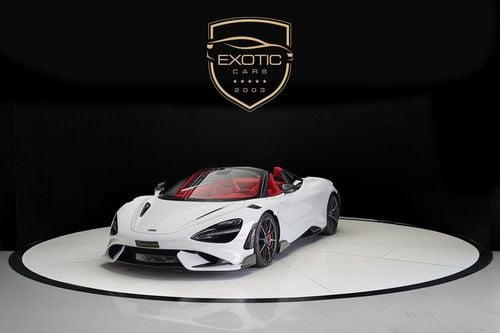
The exterior of the McLaren 765LT immediately telegraphs its more extreme intent compared to the 720S. The front splitter extends dramatically forward, formed entirely from carbon fibre and incorporating large brake cooling intakes. The headlights retain McLaren's signature swooping LED design, but the surrounding bodywork features additional venting and reshaped intakes. The bonnet uses carbon fibre construction with prominent ventilation cutouts that channel air through the front radiators and exit upward across the body.
In profile the 765LT reveals the extended rear bodywork that defines every Longtail, with the rear deck stretched and reshaped to accommodate the larger active wing and additional cooling intakes. The dihedral doors remain a McLaren signature, opening upwards and outwards with characteristic theatre. Body panels are predominantly carbon fibre, with polycarbonate replacing glass in non-critical areas to save further weight. Forged alloy wheels are unique to the LT, designed to be both stronger and lighter than standard 720S wheels, with carbon ceramic brake hardware visible behind them.
At the rear the McLaren 765LT 2026 features a substantially larger active wing than the 720S, deploying automatically at speed and tilting upward under hard braking to function as an airbrake. The quad exhaust system uses titanium construction, emerging through a redesigned rear panel with a distinctive bark that announces the car's character before it becomes visible. The diffuser is more aggressive, the rear haunches are wider, and the entire car sits lower and meaner than the standard Super Series machine. McLaren 765LT price reflects the extensive carbon fibre construction and the bespoke engineering applied to every visible surface.
McLaren 765LT Performance and Engine Specifications
Beneath the rear deck sits an extensively reworked version of McLaren's M840T engine, a 4.0 litre twin-turbocharged V8 producing 755 horsepower at 7,500 rpm and 800 Nm of torque from 5,500 rpm. McLaren engineers comprehensively revised the engine for LT duty, with new turbochargers featuring lower-inertia compressors, revised pistons, modified connecting rods, an updated lubrication system, and a higher-flow exhaust manifold. Approximately one-third of the engine components are new or modified compared to the 720S unit, demonstrating the depth of the development work.
Performance figures are nothing short of staggering. The 765LT completes the 0 to 60 mph sprint in just 2.7 seconds, with 0 to 124 mph dispatched in 7.0 seconds. Maximum velocity stands at 205 mph, but it is the in-gear acceleration and the brutality of the response that truly define this machine. Real-world performance character is savage yet remarkably controllable, with the lower-inertia turbos spooling almost instantly, the lightened rotating assembly responding with remarkable immediacy, and the soundtrack from the titanium exhaust offering one of the most evocative noises in modern supercar history.
There is no hybrid system in the 765LT, with McLaren focusing entirely on lightweight construction and combustion development. The 2026 McLaren 765LT remains a thoroughly analogue interpretation of the supercar formula, and that purity is fundamental to its appeal. McLaren 765LT price has held its value exceptionally well in the secondary market, reflecting both the rarity and the special place this machine holds in McLaren history.
Transmission and Drivetrain of the 2026 McLaren 765LT
Power flows through McLaren's seven-speed Seamless Shift Gearbox, the same dual-clutch transmission used across the Super Series range but retuned for the LT's more aggressive character. Shift speeds are 15 percent faster than the 720S in track-derived modes, with mechanical engagement that feels more direct and less filtered. The gearbox offers three modes, Comfort, Sport, and Track, each progressively sharpening shift behaviour and throttle mapping. In Track mode the changes are violent, with full ignition cut on upshifts producing audible cracks from the titanium exhaust that rival anything from Maranello.
Drive is sent exclusively to the rear wheels, the McLaren 765LT remaining true to McLaren's mid-engine, rear-drive supercar philosophy. There is no all-wheel drive option, instead the brand relies on its open differential combined with brake-based torque vectoring to manage the substantial power output. The Proactive Chassis Control II system uses interconnected hydraulic dampers with retuned settings for LT duty, providing exceptional body control while still permitting acceptable road usability. Spring rates are firmer than the 720S, the geometry has been revised, and the entire chassis has been optimised for circuit work.
Electro-hydraulic steering remains, providing the kind of feel and feedback that fully electric systems cannot match. The McLaren 765LT 2026 offers some of the most communicative steering of any production supercar, allowing the driver to feel every nuance of the road and every transfer of weight at the front axle. Combined with the active aerodynamics, the lightweight construction, and the brutal power delivery, the result is a car that responds to inputs with an immediacy bordering on telepathy.
Interior Comfort and Cabin Technology of the McLaren 765LT 2026
The cabin of the McLaren 765LT is more focused than the 720S, with weight reduction prioritised throughout the design. The standard seats are carbon fibre racing buckets with minimal padding, designed to hold the driver firmly during track work while saving substantial mass over the standard 720S items. Alcantara replaces leather across most surfaces, including the dashboard, doors, headliner, and centre console, providing a more tactile finish that reflects less light during track sessions. Carbon fibre trim is used extensively throughout, both for visual effect and to keep mass low.
Rear passenger space is non-existent given the strict two-seat layout, and front luggage capacity is modest at 150 litres. The infotainment system uses an 8-inch portrait-orientation touchscreen running McLaren's IRIS interface, supporting Bluetooth connectivity, navigation, smartphone integration through Apple CarPlay, and detailed performance telemetry. A folding digital instrument display sits ahead of the driver, flipping forward in Track mode to show only the most essential information. The Bowers and Wilkins premium audio system is available as an optional upgrade, though many buyers deleted it to save additional weight.
Comfort features are functional rather than indulgent, with manual seat adjustment standard on most examples, basic climate control, and limited storage all reflecting the track-focused brief. The vehicle lift system is available as an option, raising the nose to clear speed bumps and steep driveways. McLaren 765LT price reflects the extensive carbon fibre options and bespoke MSO customisation possibilities, with most examples specified to emphasise the lightweight philosophy rather than luxury appointments.
Safety Technology in the McLaren 765LT 2026
Safety begins with the MonoCage II carbon fibre monocoque at the heart of the McLaren 765LT, a structure that extends further into the upper body than the original MonoCell, providing exceptional rigidity with minimal mass. The structure incorporates aluminium subframes front and rear, designed to absorb impact energy through controlled deformation while protecting the cabin. Six airbags provide occupant protection in the event of a collision, including front, side, and curtain protection.
Standard driver assistance features include traction control with multiple settings, dynamic stability control with adjustable thresholds, ABS with electronic brake force distribution, brake assist, and hill start assist. Parking sensors front and rear come as standard, with a rear-view camera helping with low-speed manoeuvres. The carbon ceramic brakes deliver exceptional stopping power with strong fade resistance, vital given the car's circuit-focused capabilities. The active rear airbrake provides additional stability and stopping power under hard deceleration.
Available driver aids include cruise control, an upgraded vehicle lift system, and enhanced lighting packages. Although the 765LT has not undergone NCAP testing due to its limited production volumes, the carbon fibre structure has been extensively validated through McLaren's own crash testing program. The 2026 McLaren 765LT benefits from the engineering rigour that defines all McLaren road cars, with safety systems integrated to provide reassurance without intruding on the driving experience.
The Enduring Legacy and Lasting Appeal of the McLaren 765LT
The McLaren 765LT stands as one of the great modern Longtails, a machine that took the already phenomenal 720S and pushed it into hypercar territory. Its combination of rarity, performance, and visceral character has made it one of the most desired McLarens of recent years. Rivals such as the Ferrari 488 Pista, the Porsche 911 GT2 RS, the Lamborghini Huracan STO, and the Aston Martin Valkyrie all compete for similar attention at the extreme end of the supercar market, but each offers a different flavour. The Ferrari is more theatrical, the Porsche more visceral with its rear-engined layout, the Lamborghini more flamboyant, but the McLaren remains the most engineered, the most precise, the most singularly purposeful of them all.
McLaren 765LT price has held strong in the years since launch, with the limited 765-unit production run ensuring continued exclusivity and desirability. The combination of the MonoCage II tub, the reworked twin-turbo V8, the dual-clutch gearbox, and the hydraulically assisted steering creates a car that engages on every road and dominates on every circuit. The 2026 McLaren 765LT continues to be celebrated as one of the most extreme and rewarding driver's cars ever produced, a machine that proved McLaren could compete with anyone when it chose to build without compromise. The Longtail story continues, and this chapter may be its finest yet.
Read more 



 Engine
 Horsepower
 Transmission
 Fuel Type
 Mileage
 Seating capacity

 Premium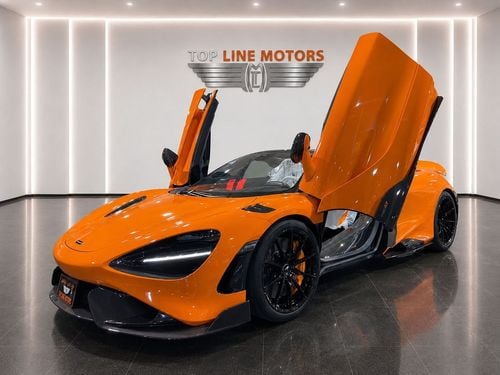








 Ferrari SF902,000,500
 McLaren 720S1,215,000
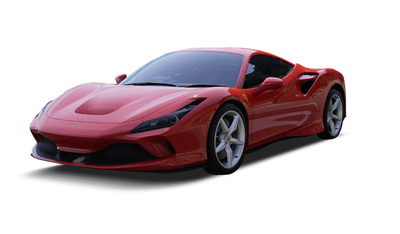 Ferrari F8 Tributo1,272,600
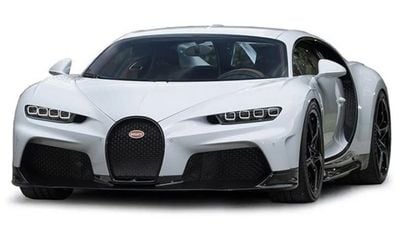 Bugatti Chiron13,220,000