The Maserati MC20 is the most significant car Maserati has produced in a generation, a mid-engined supercar that announced the Trident brand's return to the performance pinnacle after years of building its reputation on grand tourers and SUVs. Manufactured in Modena, Italy, the MC20 entered production in 2020 on an all-new carbon fibre monocoque platform developed entirely within Maserati, and the 2026 Maserati MC20 represents the most precisely calibrated and dynamically accomplished version of this revolutionary machine yet. Powered by the extraordinary Nettuno 3.0-litre twin-turbocharged V6, the MC20 is a supercar with a genuine racing lineage that begins with the car's name - MC stands for Maserati Corse. It is rear-wheel drive by design, and lighter than almost any rival in its class.
History and Development
Maserati's motorsport heritage is one of the most storied in all of European racing. The brand won the Formula 1 World Championship through Juan Manuel Fangio in 1957, and the name Maserati Corse carried weight long before the modern MC20 arrived to revive it. For decades after its 1950s glory, Maserati's participation in top-level motorsport was limited, and the brand channelled its energies into road cars of great elegance but modest dynamic ambition. The 2026 Maserati MC20 changes this narrative permanently, built from the outset as both a road car and the foundation for a racing programme that has already seen the vehicle compete globally in GT racing. The MC20's development required Maserati to create entirely new engineering competencies - including the Nettuno engine, developed with no external assistance, and a carbon fibre body and chassis manufacturing process previously unfamiliar to the factory. For buyers considering the Maserati MC20 price, the investment supports not just a product but an entirely new chapter in the brand's engineering history.
Key milestones since the MC20's debut include the introduction of the MC20 Cielo open-top variant, Maserati Corse competition versions, and the ongoing development of the Folgore electric drivetrain that will eventually expand the MC20 family further. Each step has deepened the car's credentials without compromising the purity of the original brief. The 2026 Maserati MC20 carries forward every lesson learned since launch, applied with a precision that makes this the most complete version of the nameplate to date.
Exterior Design
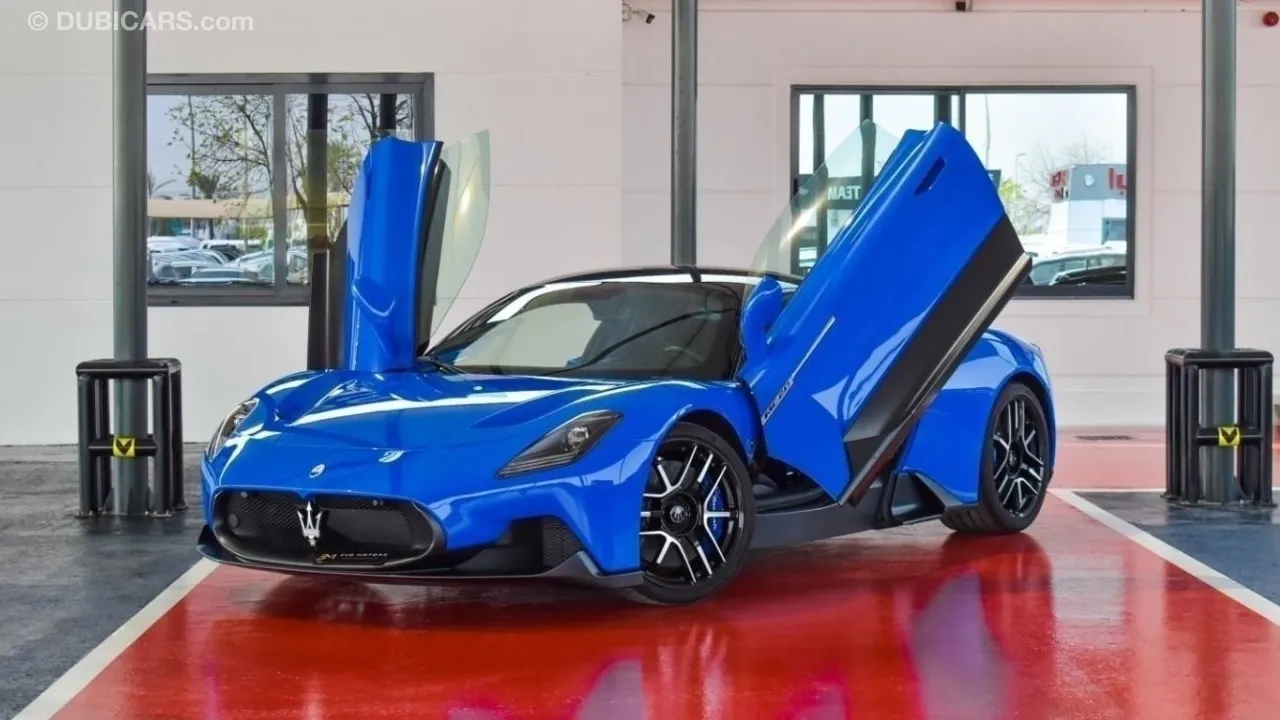
The Maserati MC20 is designed around the demands of aerodynamic efficiency and structural function, yet the result is one of the most beautiful supercar bodies of the current era. The front end is low and swept, with a narrow grille opening framed by sharp full-LED headlights and a flat underbody that channels air toward a rear diffuser with real downforce intent. Butterfly doors - a signature feature of the MC20 - add theatre and practicality simultaneously, opening upward and forward to ease entry and exit even in tight spaces. The mid-engine layout allows for a dramatically low roofline and a long, raked rear that tapers toward an active spoiler integrated cleanly into the tail. Body surfacing is smooth and taut, relying on precise aerodynamic shaping rather than grafted-on components for its downforce. Wide, sculpted wheel arches fill out the flanks and give the Maserati MC20 an imposing visual width that belies its compact overall dimensions.
The 2026 Maserati MC20 price reflects the carbon fibre construction that underpins every body panel, a level of material sophistication unusual outside the hypercar segment. Colour choices are wide and often striking, from the iconic Bianco Audace to deep Rosso Vincente, with Fuoriserie bespoke options available for buyers seeking unique specifications. The overall design language is distinctly modern while remaining recognisably Italian, with Maserati's trident badge sitting on the nose as a statement of intent rather than a marketing emblem.
Maserati MC20 Performance and Engine Specifications
The Nettuno engine is the centrepiece of the MC20's performance story, and its specification reads like something developed for a racing car rather than a road machine. The 3.0-litre twin-turbocharged V6 features a pre-chamber combustion system inspired by Formula 1 technology, producing 621 horsepower and 730 Nm of torque in road-going form. From rest to 60 mph takes approximately 2.9 seconds, a figure that matches established supercar benchmarks from Ferrari and McLaren. Top speed is 325 km/h, and the engine's delivery character is as impressive as its headline numbers - linear and predictable at low speeds, building into a ferocious top-end rush that makes the final 3,000 rpm of each gear feel like a separate performance event. The exhaust system is tuned for maximum acoustic drama, and the sound of the Nettuno at full throttle is an experience that few other road cars can provide. The Maserati MC20 price for the standard Nettuno-powered car positions it competitively against the Lamborghini Huracan and Ferrari F8 Tributo derivatives, offering comparable performance with a character that is entirely its own.
A Folgore electric version of the MC20 is in development, promising three-motor all-wheel drive performance in the 800-horsepower range with sub-three-second 0 to 60 mph capability for buyers ready to embrace the electric era. This variant will bring the MC20 story forward without abandoning the essential sporting DNA that defines this machine.
Transmission and Drivetrain of the 2026 Maserati MC20
The 2026 Maserati MC20 uses a dual-clutch eight-speed transmission mounted transversely behind the mid-placed engine, a layout optimised for the fastest possible gearchanges in both road and track conditions. Shifts in race mode are near-instantaneous, with the transmission responding to paddle inputs in a manner that rivals dedicated track cars. In comfort mode, the same transmission manages transitions smoothly enough for urban driving without feeling out of character. The MC20 is rear-wheel drive, a deliberate choice that preserves the purity of the driving experience and maximises the connection between driver and machine. Electronic torque vectoring manages the rear axle's behaviour under hard acceleration and corner exit, distributing drive intelligently to maintain stability without numbing the experience.
The adaptive suspension system allows the driver to select from multiple ride height and damper settings, and the car's behaviour changes meaningfully between each mode - from compliant and long-legged on a motorway to sharp and focussed on a circuit. The electronic stability system offers both full activation and a sport mode that allows a greater margin of slip before intervening, rewarding experienced drivers with a level of dynamic freedom that many contemporary supercars choose to withhold. The combination of light weight, rear-wheel drive, and a purpose-built carbon monocoque produces a driving experience of exceptional clarity.
Interior Comfort and Cabin Technology of the Maserati MC20 2026
The interior of the Maserati MC20 2026 prioritises the driving experience without abandoning everyday usability. The cockpit is tight and focused, with the driver and passenger positioned low in deeply bolstered carbon-composite seats that provide exceptional lateral support under hard cornering. The dashboard is clean and minimal, dominated by a central infotainment touchscreen running MIA and flanked by physical controls for the most frequently used functions. The digital instrument cluster presents all essential driving data in a clear, motorsport-derived format, with the engine's rev counter given appropriate prominence. Wireless Apple CarPlay and Android Auto are standard, and a premium audio system is available for buyers who wish to accompany their driving with music. Materials throughout the MC20 cabin include Alcantara, natural leather, and carbon fibre trim, each selected for a tactile quality appropriate to a car at this price point.
The Maserati MC20 price includes generous standard equipment, with the sport seats, Maserati's custom steering wheel with integrated paddle shifters, and full climate control among the features provided from the outset. Boot space is limited to a front trunk suitable for a weekend bag, which is entirely expected in a mid-engine supercar of these dimensions. The butterfly doors make the act of entering or exiting the MC20 feel like part of the theatre of ownership, adding to the sense of occasion that surrounds every journey in this remarkable car.
Safety Technology in the Maserati MC20 2026
Safety in the 2026 Maserati MC20 is built on a foundation of structural excellence, beginning with the full carbon fibre monocoque that provides extraordinary rigidity and energy absorption in the event of an impact. The monocoque surpasses the crashworthiness benchmarks of conventional steel or aluminium structures while weighing significantly less, contributing to the car's total weight of approximately 1,500 kg. Standard ADAS equipment includes adaptive cruise control, forward collision warning with autonomous emergency braking, lane-keeping assistance, and a rear parking camera. The braking system uses Brembo carbon-ceramic discs as standard on the MC20, a specification that more commonly appears as a cost option on competitors and speaks to the engineering priority Maserati places on stopping performance. The airbag system covers front, side, and curtain positions, adapted for the MC20's low seating position and tight cabin geometry.
Electronic stability control is calibrated specifically for the MC20's weight distribution and rear-wheel drive layout, providing meaningful assistance without reducing the car to a sanitised driving experience. The 360-degree camera system aids low-speed manoeuvring in a car whose rearward visibility is limited by the mid-engine architecture. While the MC20 is not subjected to standard consumer crash testing programmes, its structural engineering meets the requirements of both road and motorsport safety regulations applicable to its class.
The Enduring Legacy and Lasting Appeal of the Maserati MC20
The Maserati MC20 represents something deeply meaningful within the brand's history and within the broader supercar landscape. It is the car that proved Maserati could compete at the highest level of performance engineering with its own resources, without borrowing engines from Ferrari or platforms from elsewhere in the wider group. This independence gives the MC20 an authenticity that resonates with buyers who understand the significance of the achievement. Against rivals like the Ferrari F8 Tributo, the Lamborghini Huracan Tecnica, and the McLaren Artura, the MC20 offers a combination of exclusivity, acoustic drama, and Italian soul that its more volume-oriented competitors cannot fully replicate. The Maserati MC20 price asks serious money in exchange for serious substance - a complete, original supercar with a racing programme behind it and a legacy ahead of it.
For drivers who want a machine that represents the very best of what modern Maserati can achieve, the 2026 Maserati MC20 is an exceptional and entirely appropriate choice - a car whose reputation will only grow with time, because the engineering that underpins it is built to last.
Read more 


 Battery size
 Horsepower
 Transmission
 Fuel Type
 Battery Range
 Seating capacity



 Maserati MC20 Review: Italian Flair Dominates Maserati’s First Production Supercar