The McLaren Elva is a British roofless hypercar manufactured by McLaren Automotive in Woking, England, introduced in 2020 as part of the Ultimate Series alongside the Senna and the Speedtail. Built around McLaren's MonoCage carbon fibre monocoque and powered by an aggressive iteration of the M840T twin-turbocharged V8, the Elva strips away the roof and windscreen to deliver the most elemental driving experience the brand has ever created. The 2026 McLaren Elva represents the purest distillation of the open-cockpit hypercar philosophy, harking back to the legendary McLaren-Elva sports racers of the 1960s while applying every piece of modern McLaren engineering. Limited to just 149 units worldwide, this machine is among the rarest and most exclusive McLarens of the modern era.
History and Development
McLaren's history with the Elva name stretches back to the 1960s, when Bruce McLaren collaborated with British constructor Frank Nichols and his Elva company to build a series of sports racers for the burgeoning Can-Am championship. Those original McLaren-Elva machines featured open cockpits, lightweight construction, and pioneering aerodynamics, establishing principles that would define McLaren's racing philosophy for decades. When McLaren Automotive sought to add a third pillar to its Ultimate Series alongside the Senna and Speedtail, the Elva name and concept seemed perfectly fitting.
The founding philosophy of the modern Elva was simple yet ambitious, create the lightest road-legal McLaren ever, eliminate everything that did not contribute to the driving experience, and produce a machine that connected the driver to the road with absolute clarity. Engineers removed the roof, the windscreen, and the conventional cabin structure, replacing them with an Active Air Management System that channels airflow over the cabin to create a calm bubble for occupants at speed. Production was initially announced at 399 units before being reduced to 249 and finally settling at 149 examples, all hand-built at McLaren Production Centre. The 2026 McLaren Elva continues to be celebrated as one of the most exclusive McLarens of the modern era, with McLaren Elva price reflecting both its rarity and its hypercar credentials.
Exterior Design
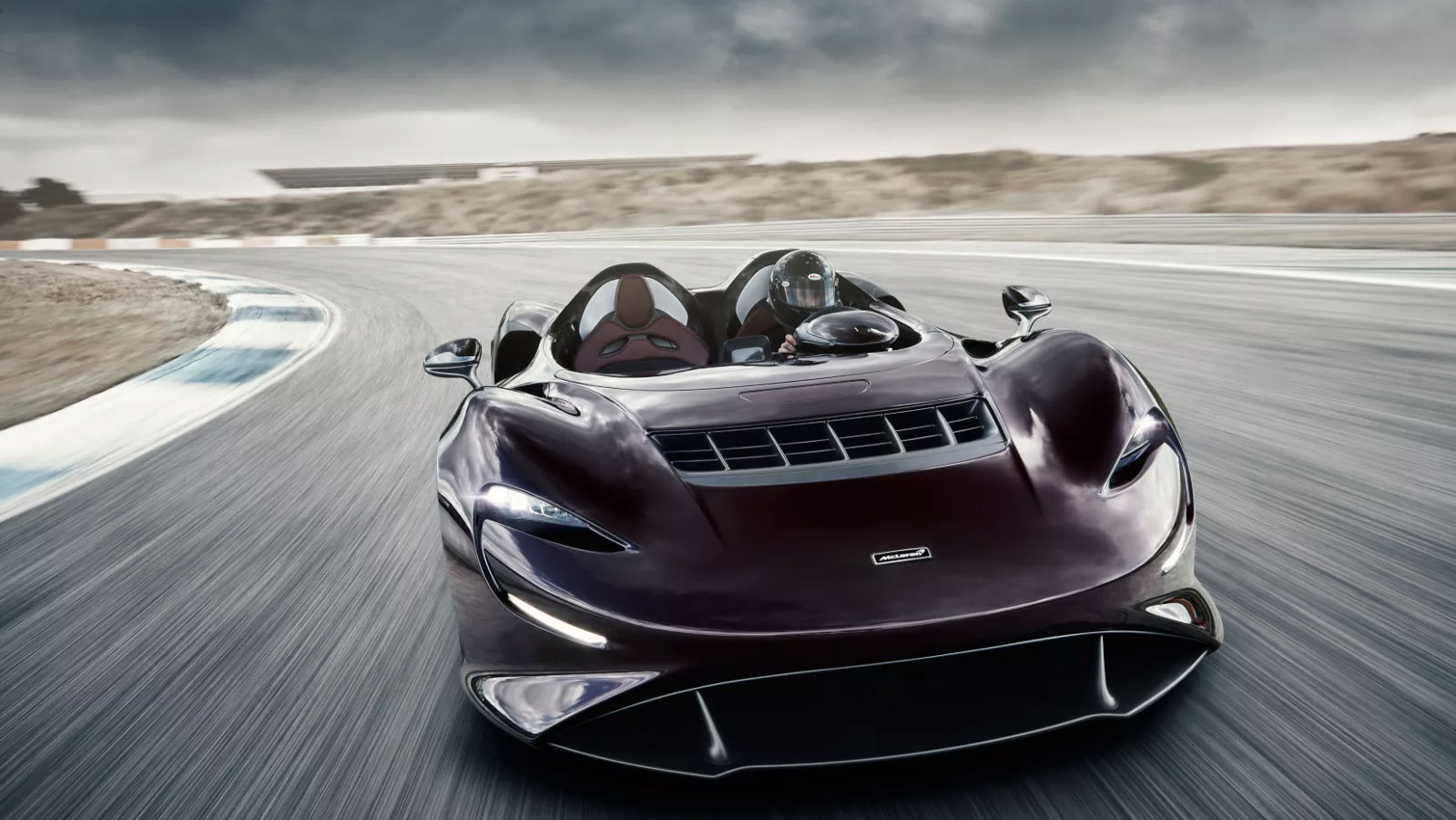
The exterior of the McLaren Elva is unlike anything else in the modern supercar landscape. With no roof, no windscreen, and no fixed side glass, the silhouette flows in a single continuous wave from the prominent front splitter through the open cockpit to the dramatic rear deck. The front fascia features McLaren's signature swooping headlights but with a more compact form, set within carbon fibre bodywork that channels air through multiple intakes and ducts. The Active Air Management System sits ahead of the cockpit, deploying automatically at speed to direct a high-pressure air stream over the occupants and create a virtual canopy.
In profile the Elva reveals its uniquely sculpted bodywork, with carbon fibre construction throughout and dihedral doors that maintain McLaren's signature theatre despite the open cockpit configuration. The wheelbase is shared with the Senna, but the bodywork is entirely bespoke, optimised for the open configuration and the active aerodynamics that define the car. Forged alloy wheels are unique to the Elva, designed to balance unsprung mass with structural integrity, and they reveal carbon ceramic brake hardware behind them.
At the rear the Elva features a dramatic active wing, multiple aerodynamic flicks, and a deeply sculpted diffuser that generates substantial downforce. The exhaust system uses titanium and Inconel construction, emerging through twin tailpipes that exit prominently from the rear deck. The McLaren Elva 2026 is offered without a windscreen as standard, though McLaren introduced a fixed windscreen option to address certification challenges in certain markets. McLaren Elva price reflects the extensive carbon fibre construction, the bespoke aerodynamic engineering, and the hand-built quality that defines every example.
McLaren Elva Performance and Engine Specifications
Beneath the rear deck of the Elva sits an aggressive iteration of McLaren's M840TR engine, a 4.0 litre twin-turbocharged V8 producing 815 horsepower at 7,500 rpm and 800 Nm of torque from 6,500 rpm. This is the same engine architecture that powers the Senna, with subtle revisions for the Elva application including a unique exhaust system designed to deliver maximum aural drama to occupants and bystanders alike. Throttle response is razor-sharp, turbo lag is minimal, and the soundtrack is unlike anything else in the McLaren range.
Performance figures push the Elva firmly into hypercar territory. The car completes the 0 to 60 mph sprint in under 2.7 seconds, with 0 to 124 mph dispatched in just 6.7 seconds. Maximum velocity is limited to 205 mph, primarily by aerodynamic considerations given the open cockpit configuration. Real-world performance character is savage yet manageable, with the engine pulling cleanly from low in the rev range and delivering a soundtrack that the open cockpit allows to permeate the cabin with full force. Brake response from the carbon ceramic discs is equally aggressive, hauling the car down from speed with shocking effectiveness.
There is no hybrid system in the Elva, with McLaren focusing entirely on lightweight construction and combustion development. The 2026 McLaren Elva remains the purest expression of the open-cockpit hypercar philosophy, and that purity is fundamental to its appeal. McLaren Elva price has remained exceptionally strong in the secondary market, reflecting both the rarity and the special character of this machine.
Transmission and Drivetrain of the 2026 McLaren Elva
Power is channelled through McLaren's seven-speed Seamless Shift Gearbox, retuned for the Elva's more extreme character. The transmission delivers shifts with the kind of speed and aggression expected from an Ultimate Series McLaren, with three modes ranging from Comfort through Sport to Track. In everyday driving the gearbox behaves with surprising civility, slipping between gears smoothly enough to suggest a refined grand tourer rather than a hypercar. Switch into Track mode and shifts become almost violent, with full ignition cut on upshifts producing audible cracks from the titanium exhaust.
Drive is sent exclusively to the rear wheels, the McLaren Elva remaining true to McLaren's mid-engine, rear-drive philosophy. There is no all-wheel drive option, with the brand relying on an open differential combined with brake-based torque vectoring to manage the substantial power output. The Proactive Chassis Control II system uses interconnected hydraulic dampers with retuned settings for the Elva's character, providing exceptional body control while still permitting acceptable road usability over normal surfaces. The McLaren Elva 2026 benefits from spring rates and damping calibration developed specifically for the open-cockpit configuration, balancing the different mass distribution and aerodynamic loads.
Electro-hydraulic steering remains, providing feel and feedback that fully electric systems cannot match. Combined with the immediate engine response, the active aerodynamics, and the lightweight construction, the result is a car that responds to driver inputs with an immediacy that borders on telepathy.
Interior Comfort and Cabin Technology of the McLaren Elva 2026
The cabin of the McLaren Elva is unlike anything else in the supercar world, with no roof, no windscreen as standard, and an open-air ambiance that connects occupants directly to their surroundings. The dashboard is sculpted from carbon fibre and wrapped in premium materials, with the design optimised for the open configuration. The seats are integrated into the carbon monocoque itself, with adjustable pedals and steering column compensating for the fixed seat positions. Materials throughout are premium, with extensive use of carbon fibre, Alcantara, and bespoke leather options through the MSO personalisation programme.
Rear passenger space does not exist given the strict two-seat layout, and luggage capacity is minimal, restricted to a small compartment behind the seats. The infotainment system uses an 8-inch portrait-orientation touchscreen running McLaren's IRIS interface, with Bluetooth, navigation, and smartphone integration supported. A digital instrument display sits ahead of the driver, configurable across multiple driving modes. The Bowers and Wilkins premium audio system is available as an optional extra, though many buyers prefer to enjoy the natural soundtrack of the V8.
Comfort features include the Active Air Management System that creates a calm bubble at speed, climate control, and integrated helmet storage. McLaren Elva price reflects the extensive MSO personalisation possibilities, with every example essentially bespoke. The cabin makes no apologies for its open configuration, this is a car designed to celebrate the connection between driver and environment, and that singular focus defines its character.
Safety Technology in the McLaren Elva 2026
Safety begins with the MonoCage carbon fibre monocoque at the heart of the McLaren Elva, a structure that extends further into the upper body to compensate for the absence of a traditional roof and windscreen. The carbon construction delivers exceptional rigidity with minimal mass, with aluminium subframes front and rear designed to absorb impact energy through controlled deformation. Airbags are integrated into the cabin where possible given the open configuration, with seatbelt pretensioners providing additional security.
Standard driver assistance features include traction control with multiple settings, dynamic stability control with adjustable thresholds, ABS with electronic brake force distribution, and brake assist. The carbon ceramic brakes deliver exceptional stopping power with strong fade resistance, vital given the performance capabilities. Parking sensors front and rear come as standard, with cameras assisting low-speed manoeuvring. The Active Air Management System contributes to safety by creating a stable aerodynamic environment around the open cockpit at speed.
Available options include cruise control, an upgraded vehicle lift system, and enhanced lighting packages. Although the Elva has not undergone NCAP testing due to its extremely limited production volumes, the structure has been validated through McLaren's own extensive testing program. The 2026 McLaren Elva benefits from the engineering rigour that defines all McLaren road cars, with safety systems thoughtfully integrated to provide reassurance without compromising the open-cockpit philosophy that defines the car.
The Enduring Legacy and Lasting Appeal of the McLaren Elva
The McLaren Elva will be remembered as one of the most singular hypercars of the modern era, a machine that paid homage to the original McLaren-Elva sports racers while applying every piece of contemporary engineering. Its combination of rarity, performance, and open-cockpit purity has made it one of the most desired McLarens ever produced. Rivals are essentially non-existent in this exact configuration, with the Ferrari Monza SP and the Aston Martin V12 Speedster offering the closest comparisons. The Ferrari is more theatrical with its retro-modern styling, the Aston Martin slightly more luxurious in execution, but neither matches the McLaren's engineering depth or its connection to such a meaningful piece of motorsport heritage.
McLaren Elva price has remained exceptionally strong in the years since launch, with the 149-unit production run ensuring lasting exclusivity. The combination of the MonoCage tub, the brilliant twin-turbo V8, the dual-clutch gearbox, and the hydraulically assisted steering creates a car that engages on every drive in a way that few machines can match. The 2026 McLaren Elva continues to be celebrated as one of the most exclusive and rewarding hypercars ever produced, a machine that proved McLaren could honour its racing heritage while pushing the boundaries of what a road car can be. Few cars have ever felt this alive.
Read more 



 Battery size
 Horsepower
 Transmission
 Fuel Type
 Battery Range
 Seating capacity



 McLaren Elva Review: 1 of 149 Open Cockpit Supercar