
AWD vs 4WD Explained: Key Differences, Off-Road Performance & Which Is Better In The UAE?
 November 6, 2026
, 9 Min Read
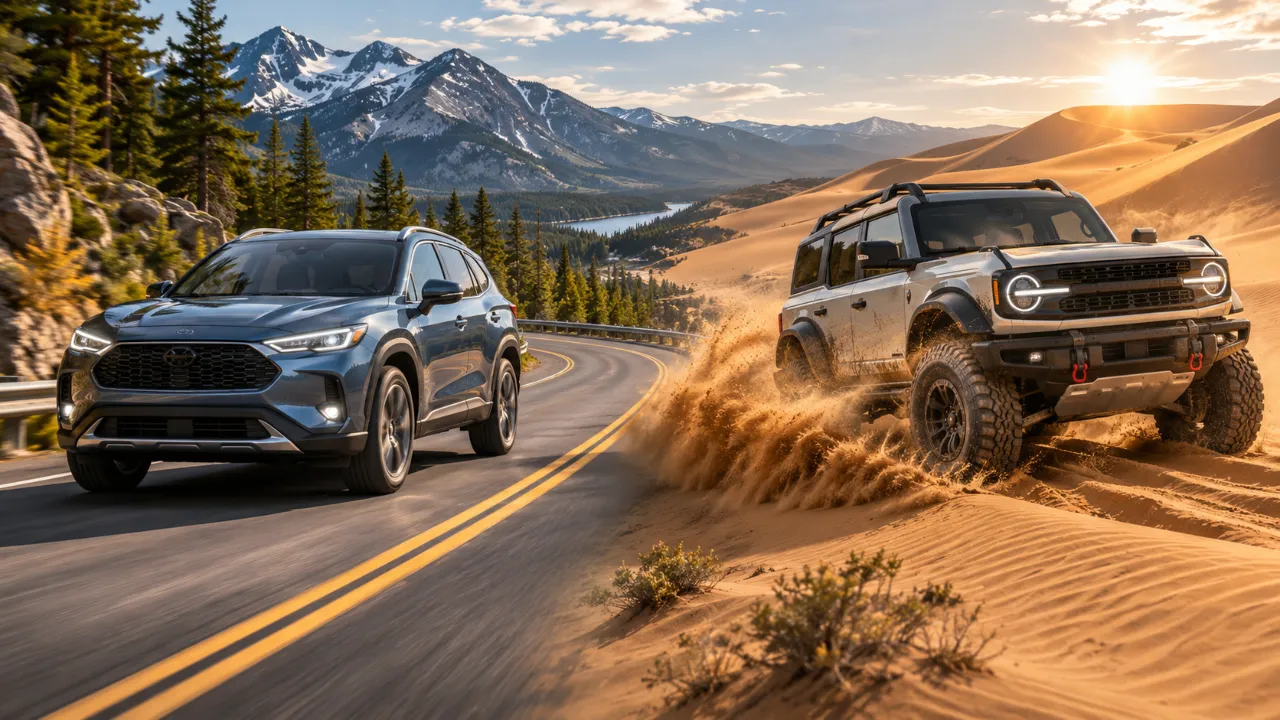
Four wheels, one engine and plenty of grip. Sounds simple, right? Well, not quite. When shopping for an SUV, you’ve probably come across terms such as All-Wheel Drive (AWD), Four-Wheel Drive (4WD) and 4×4. They sound similar, but there’s more going on underneath the car than you might think.
Both systems improve traction, but they approach the job differently. One is generally better suited to everyday driving, while the other is often built for serious off-road adventures.
 AI Quick Summary
The article distinguishes between All-Wheel Drive (AWD) and Four-Wheel Drive (4WD) systems, explaining that AWD automatically distributes power for enhanced traction in everyday driving and mild conditions. Conversely, 4WD features robust mechanical components and selectable modes for manual control, making it ideal for challenging off-road terrain like sand dunes or rocky trails.
This summary was generated by AI using this article’s content.Read Next



So, which is better for UAE roads? Can an AWD SUV tackle the desert? And do you really need a proper 4WD for weekend adventures? Let’s find out.
What Is All-Wheel Drive (AWD)?
All-Wheel Drive is a system that can send power to all four wheels to improve traction and stability. The clever part is that most modern AWD systems manage this automatically, so the driver doesn’t have to do much.
Some AWD vehicles continuously send power to both axles, while others primarily drive two wheels and engage the second axle when needed. Sensors monitor wheel speed, throttle input and driving conditions to help distribute power.
For example, when accelerating on a slippery road, an AWD system can send additional power to the wheels with better grip. It can also improve traction when pulling away or driving through corners.
AWD is common in crossovers, family SUVs, performance cars, and luxury vehicles. Cars such as the Subaru Forester and various Audi quattro models use AWD to improve everyday driving performance.
Want to understand how power reaches the wheels? Here’s our detailed guide to automotive drivetrains.
What Is Four-Wheel Drive (4WD)?
Four-Wheel Drive, often called 4×4, is generally associated with vehicles designed to handle challenging terrain. Think soft sand, rocky mountain trails, deep ruts and steep climbs.
Traditional 4WD systems use a transfer case to distribute power between the front and rear axles. Depending on the system, drivers can select different driving modes to suit the terrain.
Unlike most road-focused AWD vehicles, many dedicated 4WDs also feature low-range gearing, locking differentials and stronger off-road components.
Vehicles such as the Toyota Land Cruiser, Nissan Patrol, Jeep Wrangler and Ford Bronco are popular examples.
These SUVs are designed to go well beyond the tarmac. Some combine advanced electronics with serious mechanical hardware, giving drivers greater control in difficult conditions.
For a closer look at two legendary 4x4s, check out our Toyota Land Cruiser vs Nissan Patrol comparison.
AWD vs 4WD: What Are The Main Differences?

Although both systems can drive all four wheels, their design, operation and capabilities can differ significantly.
Power Distribution
AWD systems typically manage power automatically. Depending on the design, they can vary in how much torque reaches each axle to maintain traction.
Traditional part-time 4WD systems let drivers engage four-wheel drive when needed. When engaged, they mechanically connect the front and rear axles.
However, full-time 4WD systems can remain engaged during normal road driving, much like AWD.
Driver Control
AWD generally requires little attention. The vehicle decides how to distribute power, although some systems offer selectable terrain modes.
Traditional 4WD systems give drivers more direct control through settings such as 2H, 4H and 4L.
Off-Road Performance
AWD works particularly well on wet roads, loose gravel and mild off-road routes. However, many AWD crossovers have limited ground clearance and lack low-range gearing.
A dedicated 4WD usually handles difficult terrain better, especially when equipped with suitable tyres, differential locks and good suspension travel.
Mechanical Complexity
AWD systems often rely heavily on electronic controls and clutch systems, although mechanical centre differentials are also common.
Dedicated 4WD systems typically include a transfer case and may add locking mechanisms. Both systems can be complex, but their designs serve different purposes.
Understanding 2H, 4H And 4L In Four-Wheel Drive Vehicles
One of the biggest advantages of a traditional 4WD is the ability to choose different driving modes. Here’s what those settings mean.
2H – Two-Wheel Drive High: Power goes to one axle, usually the rear. This mode is commonly used for everyday driving on paved roads.
4H – Four-Wheel Drive High: Both axles receive power for additional traction. It is commonly used on sand, gravel and other loose surfaces. In the UAE, 4H is often preferred for dune driving where maintaining momentum matters.
4L – Four-Wheel Drive Low: Low-range gearing increases torque multiplication and provides greater control at low speeds. It is particularly useful for steep climbs, rocky terrain and certain recovery situations.
Not every 4WD uses these exact settings. Some offer full-time 4WD, automatic modes or additional terrain controls.
For example, Mitsubishi’s Super Select system combines selectable two-wheel drive with full-time and locked four-wheel-drive settings. Read about the technology in our Mitsubishi Triton L200 guide.
Importantly, do not use locked part-time 4WD modes on dry tarmac unless the manufacturer specifically permits it.
AWD vs 4WD: Which Is Better For UAE Driving Conditions?
The UAE offers everything from smooth highways to massive sand dunes. The right choice depends on where you spend most of your time.
City Driving And Highways
AWD is an excellent choice for everyday use. It provides additional traction when needed while generally offering smooth, easy operation.
However, if your daily commute involves nothing more adventurous than Sheikh Zayed Road, you may not need either system. A two-wheel-drive vehicle can be perfectly suitable.
Desert Driving And Sand Dunes
This is where a dedicated 4WD usually has the advantage.
Driving on soft sand requires suitable tyres, good ground clearance, careful throttle control and the ability to maintain momentum.
Low-range gearing and differential locks can help in certain situations, although neither should be used automatically for every dune.
AWD crossovers may handle firm sandy tracks, but deeper dunes can quickly expose their limitations.
Before heading into the desert, read our UAE desert driving guide for essential techniques and preparation tips.
Mountains And Rocky Trails
For difficult mountain trails, a dedicated 4WD with low-range gearing is generally the better option.
The additional control helps when climbing steep slopes or carefully driving over rocks. Good suspension articulation and underbody protection are also important.
AWD vehicles can handle easier gravel trails, but low ground clearance can become a problem when the terrain gets rough.
Does AWD Or 4WD Offer Better Fuel Economy?
Generally, AWD and 4WD systems can consume more fuel than comparable two-wheel-drive setups because of their additional mechanical components, weight and drivetrain losses.
However, modern on-demand AWD systems can reduce some losses by sending power to the second axle only when necessary.
Traditional 4WD vehicles are often larger, heavier and fitted with off-road tyres, which can further increase fuel consumption.
Still, the drivetrain is only part of the story. Engine size, vehicle weight, aerodynamics, tyres and driving habits can have a greater effect on fuel economy.
Can An AWD Vehicle Be A Serious Off-Roader?

Absolutely! That’s where the AWD vs 4WD debate gets interesting.
Not every AWD system is designed only for city driving. Some advanced systems offer impressive off-road capabilities.
The Land Rover Defender is a great example. Despite using an AWD system, it also features sophisticated terrain management, available differential locking and low-range gearing.
Electric off-road vehicles can take a different approach, using individual motors to control power delivery without a conventional mechanical 4WD layout.
The important lesson? Don’t judge an SUV’s off-road ability by its AWD or 4WD badge alone.
Our Jeep Wrangler vs Land Rover Defender comparison explains how two very different systems can deliver impressive off-road performance.
What Matters More Than AWD Or 4WD?
A good drivetrain helps, but it cannot perform miracles. Several other factors determine how capable a vehicle is off-road.
Tyres: The right tyres can make an enormous difference. Suitable tread patterns and correctly adjusted pressures help improve traction on different surfaces. Here’s our guide to choosing car tyres in the UAE.
Ground Clearance: More clearance helps prevent the vehicle’s underside from hitting rocks, ruts and uneven terrain.
Suspension: Good suspension travel lets the wheels stay in contact with uneven surfaces, improving traction and control.
Differential Locks: These help prevent excessive wheelspin when traction is uneven, allowing the vehicle to keep moving in difficult situations.
And, of course, driver experience matters. Even the best 4WD can get stuck when driven incorrectly.
AWD vs 4WD: Which Should You Buy In The UAE?
For most drivers who spend their time in cities, on highways and occasionally exploring easy gravel trails, AWD offers a practical balance of traction, comfort and convenience.
However, drivers planning regular desert adventures, rocky mountain trails or serious off-roading should consider a dedicated 4WD with proper off-road equipment.
There is no universal winner. The right system depends on your driving habits, budget and preferred adventures.
If you are planning to explore beyond the tarmac, check out our top off-road SUVs in the UAE.
Ultimately, AWD is generally the better everyday all-rounder, while a properly equipped 4WD is the stronger choice for demanding terrain. What matters most is having the right vehicle for the places you actually intend to drive.
Whatever car you’re thinking of, find it on Dubi with over 25,000 listings.
Stay tuned to the UAE’s most popular auto blog for more automotive content.
FAQs
What Is The Main Difference Between AWD And 4WD?
AWD automatically distributes power between the wheels for better traction, while traditional 4WD systems offer greater driver control and are generally better suited to challenging off-road terrain.
Is AWD Or 4WD Better For Desert Driving In The UAE?
4WD is generally better for desert driving in the UAE, especially on soft sand and steep dunes. Dedicated 4WD vehicles typically offer better ground clearance and off-road capabilities.
Can AWD Cars Go Off-Road?
Yes, AWD cars can handle gravel roads, light trails and firm sand. However, most AWD crossovers are less capable than dedicated 4WD vehicles on difficult terrain.
Does AWD Consume More Fuel Than 4WD?
Not necessarily. Fuel consumption depends on vehicle weight, engine, drivetrain design and driving conditions. Modern AWD systems can be more efficient than traditional 4WD setups.
Which Is Better for Daily Driving in Dubai, AWD or 4WD?
AWD is generally more convenient for everyday driving in Dubai because it manages traction automatically. However, two-wheel drive is also sufficient for most normal road conditions.
Follow us on

Recent Stories

Complete Guide To Parkin Subscriptions In Dubai
Parking in Dubai is easy until you need to do it every single day. Finding a spot is one thing,...
UAE Winter Road Trips For SUVs: The Best Routes And What To Pack
Winter in the UAE is practically an invitation to get behind the wheel. The temperatures drop, the mountains look inviting,...

Top Car Dealer For Exporting Brand-New Toyota & Hyundai LHD Vehicles From The UAE
Dubai has become one of the world’s most important automotive trading centres. Its access to major shipping routes, extensive vehicle...

Abu Dhabi Grand Prix 2026 Guide: Dates, Tickets, Concerts And Getting To Yas Marina Circuit
The Formula 1 Etihad Airways Abu Dhabi Grand Prix runs from 3 to 6 December 2026 at Yas Marina Circuit,...

Iconic Purple Cars In Movies: From The Joker To Fast & Furious
Some movie cars become famous for their speed. Others are remembered for wild stunts, unique designs, or the characters who...

Biggest Automotive Rivalries In History
Some of the greatest cars ever made were born out of competition, and sometimes even a little jealousy! From bitter...