
Car Accident History In The UAE: What Reports Can And Cannot Tell You
 September 29, 2026
, 6 Min Read
September 29, 2026
, 6 Min Read
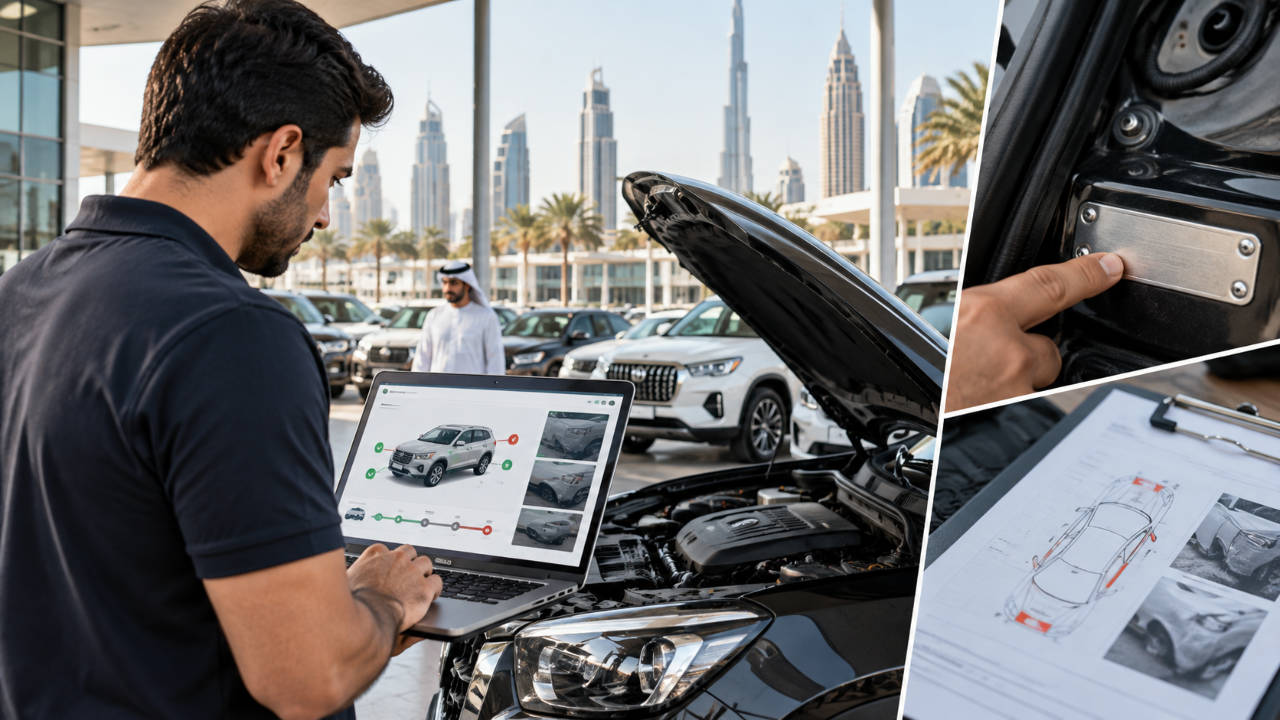
Checking a car’s accident history should be one of the first steps when buying a used car in the UAE. A chassis number or VIN can reveal previously reported accidents and help buyers identify vehicles that need closer inspection.
However, a clean accident-history report does not necessarily mean that a car has never been damaged, repaired, flooded or involved in an accident outside the UAE. Understanding what these reports can and cannot tell you is therefore essential. Here is our detailed guide to checking car accident history in the UAE.
 AI Quick Summary
In the UAE, buyers can check a used car's accident history using its chassis number (VIN) through official services like Emirates Vehicle Gate, the Ministry of Interior, and emirate-specific police departments. However, a clean report does not guarantee the car is free from all damage, such as imported or flood damage, nor does it reveal repair quality, accident severity, or its full mechanical history, necessitating further physical inspections.
This summary was generated by AI using this article’s content.Read Next



Where Can You Check Car Accident History In The UAE?
No single report should be treated as a complete record of everything that has ever happened to a vehicle. Depending on its registration and previous history, buyers may need to check more than one service. Before starting, you will need the chassis number or VIN. Read our guide to checking a car’s chassis number in the UAE for more details.
Emirates Vehicle Gate
Emirates Vehicle Gate (EVG) allows buyers to check available accident information using the chassis number. It is particularly useful for vehicles whose records are available through federal traffic systems.
Ministry of Interior
The UAE Ministry of Interior (MOI) provides vehicle-related traffic services where available accident information can be checked.
Abu Dhabi Police
Abu Dhabi Police Vehicle Accidents Inquiry allows users to enter a chassis number and retrieve accidents recorded against that vehicle, including available details of individual incidents.
Dubai Police
Vehicles with a history in Dubai should also be checked through Dubai Police services. Buyers should not assume every Dubai record will automatically appear in federal databases.
If you have recently been involved in a collision, our guide explains how to file an accident report across the UAE.
What About The RTA Technical Vehicle Status Report?
The RTA Technical Vehicle Status Report costs AED 120 and provides useful historical information about a Dubai vehicle. However, RTA specifically states that the report does not include vehicle accident data. It may include information such as ownership and insurance history, but use it as an additional vehicle-history check rather than the primary accident search.
What Can An Accident-History Report Tell You?
Depending on the authority and available records, an accident-history search may show:
- Whether an accident was officially recorded
- Number of recorded accidents
- Accident date
- Accident location
- Report or accident reference number
- Additional accident details in some cases
This can help you check whether a seller’s description matches the official history. However, the important thing is that it is recorded.
Accident Count Does Not Tell You Accident Severity
One recorded accident does not automatically make a car a bad purchase.
A bumper impact is very different from a collision involving chassis rails, pillars, suspension mounting points or airbags. Likewise, two minor accidents could be less concerning than one major structural collision.
When an accident appears, investigate where the vehicle was hit, how serious the impact was, what parts were replaced and whether structural or airbag repairs were required.
You can also check for physical clues using our guide on how to tell if a used car has been in an accident.
Reports Cannot Tell You The Quality Of Repairs

An accident record confirms an incident. It does not confirm whether the vehicle was repaired properly.
Poor panel alignment, non-factory welds, chassis damage, incorrect suspension geometry or improperly repaired safety systems may only become apparent during a physical inspection.
A professional inspection can also examine paint thickness, chassis rails, the underbody, airbags and electronic fault codes. Read our complete UAE pre-purchase car inspection guide for the checks buyers should carry out.
Imported Cars Need Additional Checks
Imported cars are one reason you should interpret a clean UAE history carefully.
A vehicle could have been involved in an accident, declared salvage, repaired overseas and then imported into the UAE. A local database cannot automatically reconstruct incidents that happened before the vehicle entered the country.
Read our guide on what to know before buying an imported car in the UAE.
This is particularly relevant for American imports. Buyers considering one should also understand the wider differences between GCC-spec and American-spec cars and check the vehicle’s overseas VIN history wherever reliable records are available.
Flood Damage May Not Appear As Accident History
A car can have no recorded traffic accidents and still have suffered serious water damage.
Corrosion beneath seats, moisture under carpets, electrical faults, sediment in hidden areas and unusual cabin smells can indicate previous flooding.
Our guides explain how to check a car for flood damage and whether you should buy a flood-damaged car.
A clean accident report therefore does not confirm that a vehicle has never suffered other serious damage.
Accident History Is Not Mechanical Or Service History
A car with no recorded accidents can still be poorly maintained.
Accident databases generally do not tell buyers about engine servicing, gearbox maintenance, previous overheating, suspension wear or long-term mechanical neglect.
Service records, workshop invoices and an independent inspection remain important. Our used-car buying checklist for the UAE covers the wider checks buyers should complete before purchase.
How To Check A Used Car Properly
Start by getting the full VIN and matching it against the registration card and the number physically displayed on the vehicle. Check the relevant UAE accident databases and use emirate-specific police services where necessary.
For imported cars, also investigate overseas history. Ask the seller for accident reports, repair invoices, insurance documents and photographs where available.
Finally, get an independent pre-purchase inspection even if the online history appears clean. Warning signs such as mismatched paint, uneven panel gaps, unexplained warning lights and inconsistent seller information should always be investigated further. Read our guide on how to spot a bad used-car deal in the UAE for more red flags.
Should You Buy A Car That Has Been In An Accident?
A previous accident does not automatically make a used car a bad purchase. Minor damage that was professionally repaired can differ greatly from serious structural damage. Your decision should depend on the accident’s severity, the areas affected, repair quality, current condition, and whether the asking price reflects its history.
Likewise, a vehicle with no recorded accidents should not automatically be considered better if it has hidden repairs, poor maintenance or mechanical problems.
Find the best used cars for sale in the UAE.
Stay tuned to the UAE’s most popular auto blog for more on the latest happenings across the Emirates.
Follow us on

Recent Stories
Can You Own An EV In Dubai Without Home Charging?
Electric cars are becoming easier to own in Dubai thanks to longer ranges and a growing charging network. But can...

Toyota Land Cruiser LC200 vs LC300: Which Should You Buy In The UAE?
The Toyota Land Cruiser LC300 replaced the LC200 in 2021, ending a generation that had been on sale for almost...
Complete Guide On How To Place Requests With RTA In Dubai
Dubai’s Roads and Transport Authority (RTA) manages roads, public transport, vehicle and driving services across the emirate. Residents and visitors...
How To Get The Best Car Loan Interest Rate In The UAE For Used & New Cars
Getting the lowest possible car loan rate in the UAE is not just about finding the bank advertising the smallest...

Is It Safe To Sleep In A Car? Risks and Safety Tips
Long drives, road trips and late-night journeys can leave drivers feeling exhausted. In those situations, pulling over for a short...
A Complete Guide To RTA Bus On-Demand Service In Dubai
Dubai’s public transport network continues to expand, and the RTA Bus On Demand service is becoming an increasingly useful option...